
How to Get More Out of Every Treadmill Run (Without Running Longer)

There is a moment that happens in almost every treadmill run.
You glance at the clock. You adjust the speed. You settle into a rhythm and just… keep going.
Maybe you are squeezing this run in between drop-off and a full day of meetings. Maybe the Atlanta heat won out and the treadmill was the smarter call. Either way, you showed up — and that matters.
But here is what we see, time and again: the treadmill is one of the most underutilized tools in a runner's routine. Not because people aren't working hard. But because most runs are treated as miles to log rather than moments to learn from.
And that distinction? It changes everything.
Your Body Is Always Communicating. Are You Listening?
Running is one of the most repetitive things you can ask your body to do. Thousands of foot strikes per mile. Countless micro-decisions made by your nervous system, your joints, your muscles, all working together to keep you upright and moving forward.
That repetition is a gift when your mechanics are working well.
But when they are not? Repetition simply reinforces the pattern that is already there. And over time, those small inefficiencies accumulate, not just into stalled performance, but into the nagging aches, the recurring tightness, the "I don't know why this keeps flaring up" frustrations we hear from so many of our clients.
The treadmill, used with intention, offers something that outdoor running simply cannot: a controlled environment where you can tune in to how you are actually moving, not just how far or how fast.
That is a remarkable opportunity. Most runners never take it.
Why More Miles Isn't Always the Answer
There is a deeply ingrained belief in the running community that progress equals volume. More miles. More time on your feet. More effort.
And for a season, that works.
But for the active adults we work with, the ones juggling careers, families, weekend races, and the very real desire to still feel good in their bodies at 50, 60, and beyond, the "just run more" approach often has diminishing returns. It can even become counterproductive, building fitness on top of a foundation of compensations that have never been addressed.
Here is the truth: your body is extraordinarily good at adapting. It will find a way to complete your run, even if that means redistributing load to joints and tissues that were never meant to carry it. That adaptation feels fine… until it doesn't.
Sustainable running is not just about cardiovascular fitness. It is about how efficiently your whole system moves. And that is where the treadmill becomes less of a piece of cardio equipment and more of a diagnostic tool.
What Most Treadmill Runs Are Missing
The habits that limit treadmill training are rarely dramatic. They are subtle, and they are nearly universal:
Running at the same pace, every single session
Letting stride length creep longer as fatigue sets in
Gripping the rails during incline work, which completely offloads the demand you were trying to create
Zoning out rather than tuning in
Treating the session as cardio only, disconnected from how you actually move.
None of this is "wrong." But it represents a significant missed opportunity — especially for someone who is serious about their long-term health and performance.
Because on a treadmill, you have something rare: consistency. The belt speed stays constant. The surface doesn't change. The variables are removed. That gives you an extraordinary window to observe yourself, to experiment, and to build better patterns in a way that is almost impossible on a trail or a road.
Form Is Not a Performance Detail. It Is a Health Investment.
When we talk about running form at Functionize, we are not talking about aesthetic perfection or competitive elite technique. We are talking about efficiency — moving in a way that distributes force well, protects your tissues over time, and supports the kind of longevity that lets you keep doing what you love.
A few simple anchors can shift your entire system.
Run tall, not rigid. Head stacked over shoulders, shoulders over hips. This is not just posture. It is creating space for your breathing, your hip mechanics, and your overall rhythm to work together. When you collapse forward, everything downstream has to compensate.
Think lighter, not harder. A slightly quicker cadence — what runners often describe as feeling "quieter" underfoot — reduces overstriding and changes how your body absorbs impact. It is one of the most effective form adjustments available, and it does not require any equipment or expertise to begin practicing.
Land under yourself, not in front of yourself. Reaching forward with your foot creates a braking force with every step. It is like running with the parking brake partially engaged. When you land closer to your center of mass, your momentum stays forward instead of being interrupted.
The beautiful thing about these cues is that you do not need to chase all of them at once. One cue, practiced with consistency, can create a ripple effect through your entire movement system. That is what we mean when we talk about running smarter. It is incremental, it is sustainable, and over time, it is transformative.
Using Incline and Speed as Tools, Not Just Challenges
One of the greatest advantages of the treadmill is precision. You can change incline and speed in seconds, and when you use those adjustments thoughtfully, you have a remarkably sophisticated training tool.
Incline is not just about burning more calories or making the run harder. A moderate incline can actually encourage better mechanics, activate the posterior chain more effectively, and in some cases, reduce impact forces compared to flat running. It changes what your body has to do, and watching how you respond to that shift is information.
Speed changes are not just about pushing limits. They invite different rhythms, different levels of body control, different demands on your coordination and tissue. When you move faster for a short interval and then return to a steady pace, you are creating contrast, and contrast is where awareness lives.
Instead of setting a number and switching off, try asking:
Can I maintain my form when the demand changes?
What does my body do differently at a higher incline — and is that what I want it to do?
Where do I feel effort arriving first?
These are the questions of someone who is not just training, but building a relationship with their body. And that relationship pays dividends far beyond the treadmill.
A Simple Framework for a More Intentional Run
You do not need more time. You need more purpose within the time you already have.
Start easy. Give yourself several minutes to settle into your natural rhythm before you ask anything specific of your body. This is not a warmup formality — it is a chance to take stock of where you are today, physically and mentally.
Layer in challenge. Short intervals of increased speed or incline disrupt autopilot and give you data. Notice what happens. Notice where you tighten, where you compensate, where you feel most in control.
Return to steadiness. After each interval, come back to an easy pace with one form cue in mind. Let the challenge inform the recovery.
Close with intention. A gradual cooldown is not just physiological. It is an opportunity to let your nervous system integrate the work. Let your body absorb what just happened.
Even within 20 to 30 minutes, this kind of structure creates a fundamentally different run. Not longer. Not necessarily harder. But more useful to the body you are trying to build and protect.
When Awareness Alone Isn't Enough
There is a ceiling to what self-coaching can accomplish. And we say that not to diminish your efforts, but to honor them.
If you are navigating recurring aches that come back no matter what you do, if your performance has plateaued despite consistent training, if something in your stride just feels off and you cannot identify why, it may not be a motivation problem or a mileage problem. It may be a movement pattern that needs a trained eye.
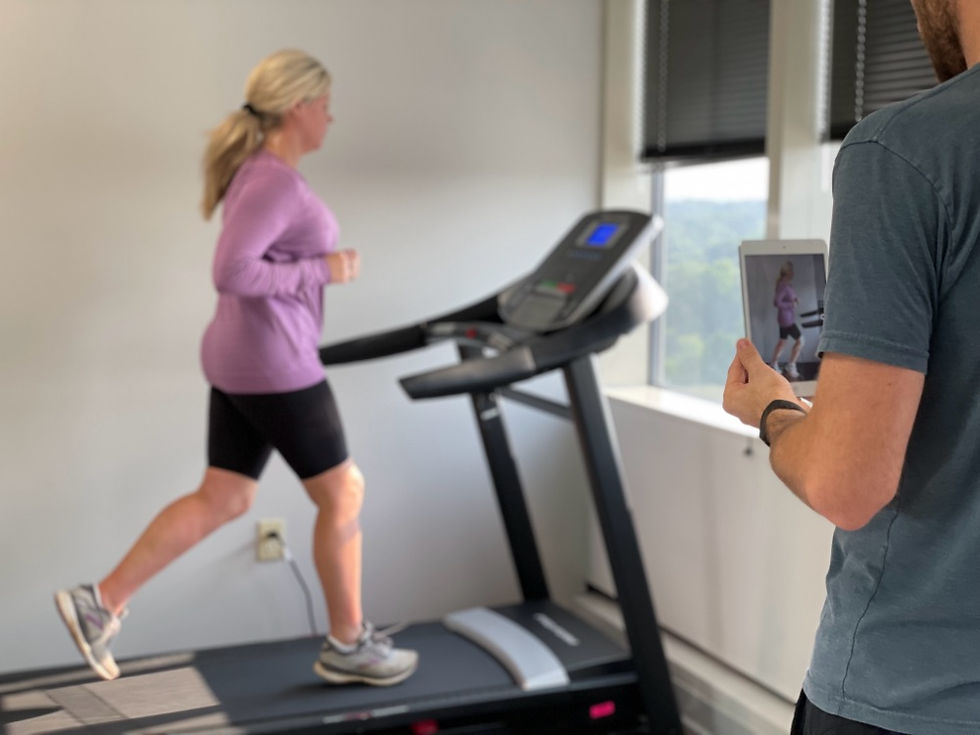
A professional running analysis connects what you feel to what is actually happening in real time. It reveals the compensations you cannot see in yourself, the load patterns that are creating stress in places you have not yet noticed, and most importantly, what to actually do about it.
This is the intersection of proactive and reactive care that we believe in at Functionize. You should not have to wait for injury to justify investing in how you move. And if you are already managing something, understanding your mechanics is often the missing piece in why it keeps returning.
The goal is not perfect form. It is movement that is efficient, sustainable, and built to carry you through the active life you want to live, for a very long time.
The Treadmill Is a Starting Point, Not a Consolation Prize
The treadmill is not where you run when you cannot do the "real thing." It is one of the most valuable feedback tools available to any runner who wants to understand their body better, and keep moving well for the long haul.
When you stop treating it as a miles machine, something shifts. Your awareness sharpens. The work compounds. And if you are ready to take that a step further, a running assessment at Functionize can show you exactly what your body is doing and what to do about it.
You were made to move. Let's make sure you are moving well.


Comments